
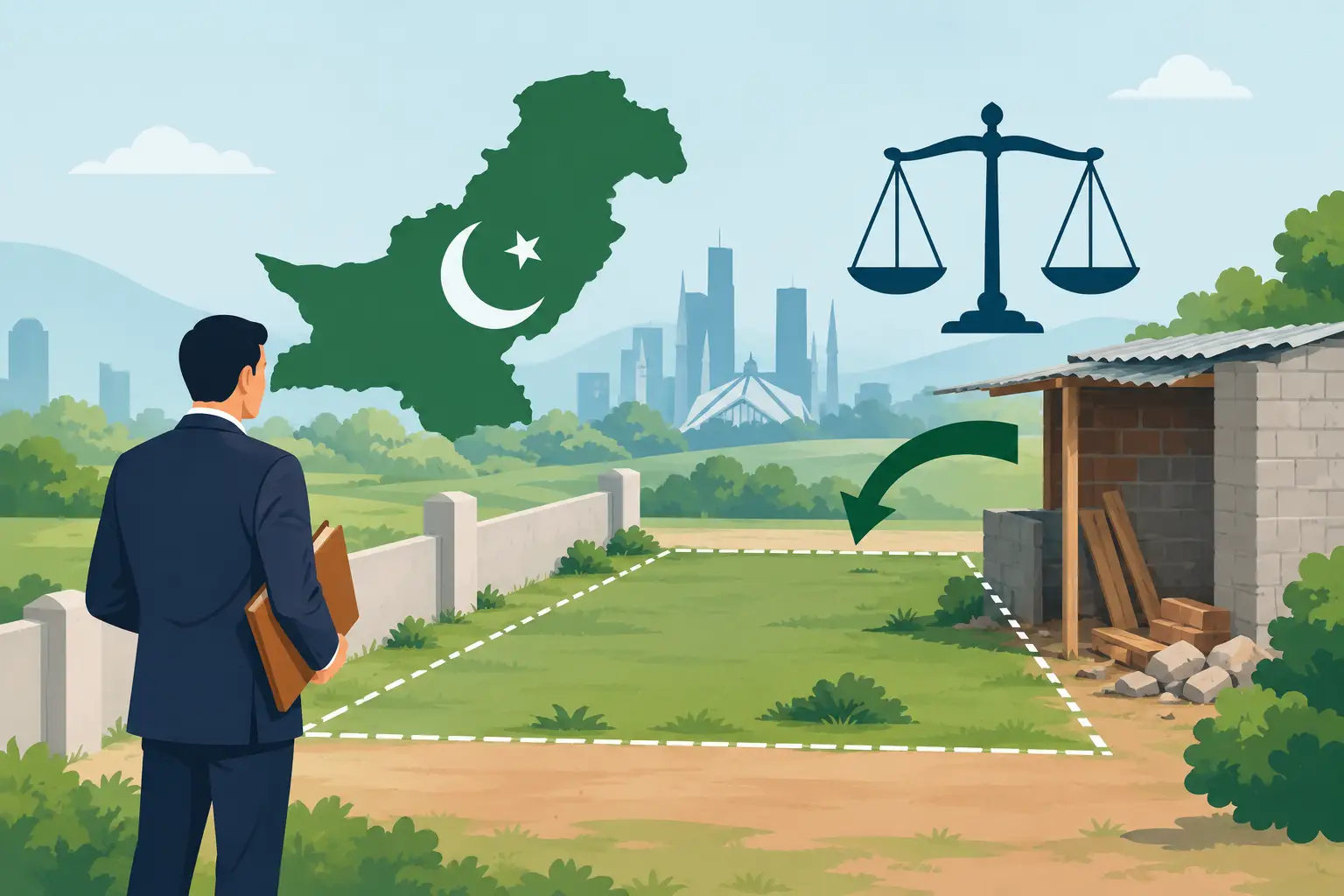
Learn how to recover encroached property in Pakistan with evidence, local action and the right legal route, while protecting your interests from the UK.
A vacant plot in Pakistan can look perfectly safe from the UK until a neighbour moves a boundary wall, a tenant refuses to leave, or a relative quietly takes control of the keys. To recover encroached property in Pakistan, you need more than a photocopy of an old registry document and a few phone calls. You need verified facts, a clear record of possession, and independent local action that protects your position rather than someone else’s commission.
For overseas Pakistanis, the risk is rarely just the occupation itself. It is the time lost while different local contacts offer conflicting advice, documents go unchecked, and the occupier becomes more established on the ground. Early, organised action can make a difficult case more manageable. Rushed confrontation can make it worse.
First establish what kind of encroachment you are facing
Not every person on your land or in your house is legally in the same position. The right recovery route depends on how they entered, what documents exist, and whether they are claiming a right to stay.
A straightforward qabza case may involve someone who has occupied vacant land, extended into your plot, built a wall over the boundary, or taken possession of an empty house without permission. Other cases are less clear. A tenant may have remained after an agreement ended. A caretaker may claim that they were promised the property. A family member may be occupying inherited property before ownership has been formally transferred. A neighbour may insist that the disputed strip of land belongs to them.
These distinctions matter. Calling every dispute “encroachment” can lead to the wrong strategy. A genuine tenant dispute may require action through the relevant tenancy process, while a boundary dispute may depend heavily on official measurement and revenue records. Where inheritance is unresolved, recovery may first require proof of the heirs’ rights and completion of ownership transfer.
Before anyone promises a quick result, insist on identifying the exact nature of occupation and the evidence behind it.
Do not act on verbal assurances
Many overseas owners are told that their documents are “fine” by someone who has not checked the registry, mutation history, plot dimensions, possession record, or the identity of the person occupying the site. That is not verification. It is reassurance without accountability.
Start by building an evidence file. This should bring together the title and transaction documents available for the property, along with current on-ground evidence. Depending on the property and province, this may include the registered sale deed, allotment or transfer letter, fard or record of rights, mutation entries, tax receipts, site plan, possession letter, and any prior correspondence with tenants, neighbours or authorities.
Current evidence is equally important. An independent site inspection can establish whether the property is occupied, who appears to be in possession, whether construction has taken place, whether boundaries have moved, and whether utilities are being used. Dated photographs, video, measurements, local witness information and a written inspection report can help turn an uncertain story into a documented case position.
Do not rely solely on images sent by a local relative, dealer or security guard. They may be well meaning, but they may also have incomplete information or a personal interest in the outcome. The person checking the property should be working for you alone.
Check the paper trail against the ground reality
A document can be genuine yet fail to resolve the immediate problem. Your registry record may show ownership, while the land on the ground has been fenced differently for years. An old site plan may not match later development. A housing society’s internal record may conflict with revenue documentation, or a purported transfer may never have been registered properly.
This is why document checks and physical inspection should be carried out together. The question is not simply, “Do we have papers?” It is, “Do the official records, physical boundaries and possession history support the same position?”
Preserve your position before the occupation deepens
An occupier who is allowed to remain without challenge may later try to present their stay as accepted, longstanding or based on an alleged agreement. You should avoid informal deals, cash settlements and verbal promises unless they have been properly assessed and documented.
That does not mean arriving with private security or asking relatives to force entry. Self-help action can trigger violence, criminal allegations and damage to your own case. It is especially risky when you are abroad and cannot supervise what happens next.
Instead, preserve evidence, record all communication, and obtain advice on the appropriate formal notice or complaint. If there is a real risk of construction, sale, damage or transfer to another party, prompt local legal action may be necessary to seek protection while the ownership and possession issues are determined. The correct route will depend on the facts, location and available records.
Use the right route to recover encroached property in Pakistan
There is no single office that resolves every property occupation case. Pakistan’s property system involves revenue authorities, housing societies, police, local administration and civil courts, with different roles depending on the dispute.
Where a boundary is disputed, an official demarcation or measurement process may be central. Where land records are wrong, incomplete or suspicious, record verification and corrective action may need to come first. Where unlawful occupation is alleged, a formal complaint and legal proceedings may be considered. Where a tenant has overstayed, the tenancy documentation and the applicable forum will shape the route.
The practical challenge is coordination. A lawyer may handle litigation, but may not inspect the site, verify whether a wall has moved, attend a society office, obtain fresh local evidence or keep an overseas client informed in plain English. A local agent may know the area, but may be tied to the occupier, developer or a commission opportunity.
A client-side property advocate fills the operational gap: checking the facts on the ground, organising documentation, coordinating the appropriate local professionals, following up with relevant offices and reporting back to the owner. NRP Properties does not sell property or represent the other side. Its role is to protect the client’s interests through independent verification and on-ground representation.
Be careful when giving authority from the UK
If you cannot travel to Pakistan, you may need to appoint someone to act for you. This should be approached carefully. A broad, poorly drafted power of attorney can create fresh risk, particularly if it allows the attorney to sell, transfer, mortgage or compromise rights without clear limits.
Authority should match the task. You may only need someone to inspect, obtain records, submit an application, issue notices, attend meetings or coordinate with a lawyer. If wider authority is required, make sure the scope, duration and conditions are clear, correctly executed and suitable for use in Pakistan.
Choose representatives for accountability, not convenience. A distant relative may be trusted socially but may not have the time, expertise or neutrality required for a contested property matter. Equally, a local fixer who promises access to every official may be creating a problem rather than solving one.
What a credible recovery plan should look like
A serious recovery plan should not begin with promises of eviction within a few days. It should begin with a written understanding of ownership, possession, risk and next steps.
You should expect clarity on what has been verified, what remains uncertain, which records are required, who is occupying the property, and what practical or legal options are available. You should also understand likely costs, local dependencies and the difference between a quick negotiated handover and a contested recovery process.
Negotiation can sometimes be sensible, especially where a tenant has simply overstayed or a family dispute can be resolved with documented consent. But negotiation should never mean surrendering your position because the other party is louder, local or politically connected. Any settlement must be checked carefully, recorded properly and followed by physical handover, document control and updated possession evidence.
After recovery, secure the property properly. Change locks where appropriate, install visible boundary markers, update caretaker arrangements, retain fresh photographs and organise regular inspections. A recovered property that is left vacant and unmanaged can be targeted again.
Your property in Pakistan should not become a permanent source of anxiety simply because you live in Britain. The strongest first move is not a dramatic confrontation. It is an independent assessment that replaces rumour with evidence and gives you control over what happens next.
Need advice on your own situation?
Every property situation is different. Tell us what you are dealing with and we will tell you where you actually stand before you spend anything.
Request a free assessment