
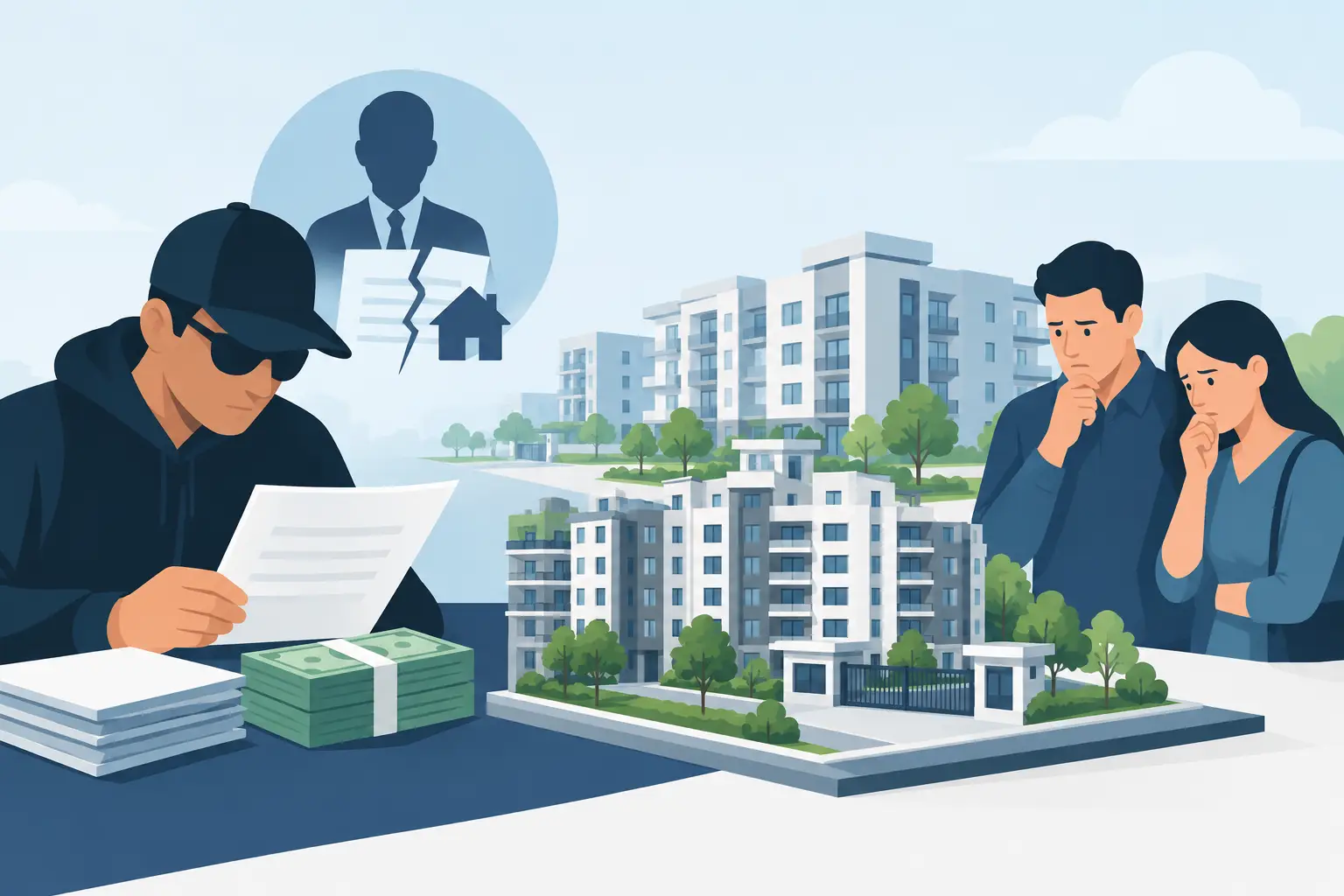
A housing society fraud example Pakistan buyers should understand: how fake schemes, false files and conflicted agents put overseas funds at serious risk.
A housing society fraud example in Pakistan rarely begins with an obvious forgery. It often starts with polished brochures, convincing WhatsApp messages, a familiar contact in Pakistan and a promise that prices will rise next month. For UK-based Pakistanis, the problem is not simply identifying a bad scheme. It is proving what exists on the ground, who owns the land, whether approvals are genuine and whether the person taking your money has any authority to do so.
Consider a common scenario. A buyer in Birmingham is offered a residential file in a proposed society near a growing city. The seller says the scheme is approved, development work is under way and several overseas Pakistanis have already invested. A relative visits the site, sees boundary walls and a sales office, and reports that it looks legitimate. Payment is made in stages. Months later, the buyer learns that the society has no valid approval for the plots being sold, the land is subject to competing claims, or the plot number exists only on a marketing map.
The sales office was real. The paperwork may even have looked official. Yet the asset the buyer believed they had purchased was not legally secure.
How housing society fraud is usually structured
Not every delayed project or poorly managed society is fraudulent. Development can be slow, approvals can be contested and infrastructure can take years. The risk arises when someone makes representations they know cannot be supported, hides material facts or sells rights they do not own.
In one form of fraud, land is advertised as part of an approved housing society before the relevant planning or development authority has approved the scheme. Buyers are shown a layout plan, plot dimensions and payment schedule, but there is no reliable evidence that the authority recognises those plots. A society may have approval for a limited area while sales staff market additional land outside it. This distinction matters: a valid approval for one block does not legalise every file offered under the same brand name.
Another familiar pattern is double allocation. The developer or dealer issues documents for the same plot to more than one buyer, often taking advantage of weak internal records and buyers living abroad. A buyer may only discover the conflict when attempting possession, construction or transfer.
There are also cases where the underlying land itself is problematic. It may be agricultural land presented as residential, land subject to inheritance disputes, land under litigation, government land, or land held by parties who cannot lawfully transfer it. A glossy booking form cannot cure a defective title.
The most difficult cases involve a mix of truth and misrepresentation. There may be genuine land, genuine construction and some genuine customers. That does not automatically make the particular file, plot or promised approval secure. Fraud often survives because it is built around enough visible reality to discourage careful questioning.
A housing society fraud example in Pakistan: what went wrong
Take a composite example based on risks frequently faced by overseas buyers. An individual in the UK is offered a 10-marla plot through a family introduction. The dealer sends photographs of roads, gates and houses already built. He provides a receipt, membership certificate and an allocation letter. He also says the seller is a "direct investor", so a quick decision is needed.
The buyer pays a substantial amount from the UK. No independent person checks the society office records, verifies the seller's chain of ownership or confirms whether the plot sits within an approved and transferable area. The documents are accepted because they carry stamps and signatures.
Two years later, the buyer asks for possession. The society says the plot number has changed under a revised layout. The seller cannot be traced. The new plot offered is in an undeveloped area, and another claimant says they were allotted the original plot first. Further checks show that the marketed block was not included in the approval relied upon by the dealer.
Several failures occurred at once. The buyer relied on the party with a financial interest in the sale. The documents were reviewed in isolation rather than tested against official records and physical reality. Nobody established whether the plot was identifiable on the ground, whether it was free from prior claims, or whether the person selling it had a clean right to do so.
This is why a visit by a relative, while useful, is not the same as independent verification. A site can look active and still fail the legal and ownership checks that protect your money.
The warning signs that deserve a pause
Pressure is one of the clearest warning signs. Statements such as "the file will be gone today", "you can verify after booking" or "everyone buys this way" are designed to replace evidence with urgency. A legitimate transaction should withstand sensible questions before funds are committed.
Be equally cautious where the price is significantly below comparable plots without a clear, documented reason. A discount may reflect genuine distress, but it can also reflect disputed ownership, an unapproved location, unpaid dues or a file that cannot be transferred.
Documents that only prove a payment was received are another concern. Receipts, booking forms and informal allotment letters may form part of a transaction record, but they do not by themselves establish title, authority or approval. Nor should you assume that a stamp, letterhead or photocopy is authentic because it looks professional.
The identity of the intermediary matters too. A dealer paid by the seller or developer is not acting solely for you. Their commercial incentive is to complete the deal. That does not mean every agent is dishonest. It does mean the buyer needs an independent layer of protection, particularly when they are overseas and cannot attend offices or inspect the site themselves.
What should be checked before any payment
The depth of due diligence depends on the type of property, location and value. Buying a developed plot with a registered deed requires different checks from purchasing a file in an early-stage scheme. However, four lines of enquiry should not be skipped.
First, verify the society and its claimed approvals with the relevant authority rather than relying on a sales brochure or verbal assurance. Confirm what has actually been approved, the land covered by that approval and whether the specific block or plot falls within it. Approval status can change, so old copies should not be treated as current proof.
Second, examine the ownership trail. Who owns the land or holds the transferable rights? How did they acquire them? Is there a break in the chain, an inheritance issue, a power of attorney, a mortgage, a court dispute or a restriction on transfer? The answer must be supported by records, not merely assurances.
Third, check the society's own records and financial position. Ask whether the file is transferable, whether instalments, development charges or penalties are outstanding, and whether the plot has been cancelled, relocated or already allotted. A seller can present a document that was once valid but no longer carries the rights being promised.
Finally, inspect the location physically. An on-ground inspection should compare the actual site with the paperwork: access roads, demarcation, possession, development level, surrounding land use and any signs of occupation or competing claimants. Maps and satellite images are useful, but they do not replace local enquiries and a proper site visit.
If you have already paid
Do not keep sending money simply because you have already paid a deposit. Fraudsters and conflicted intermediaries often use the money already committed to demand "transfer fees", "clearance charges" or a final payment that supposedly resolves the issue. Pause, preserve every receipt, message, bank record, brochure and document, then establish the facts independently.
Avoid public accusations before the position is verified. They can complicate negotiations and legal options, particularly where there is a genuine contractual dispute rather than deliberate deception. The priority is to secure evidence, identify the parties involved, check the records and decide whether recovery, cancellation, transfer correction or formal action is justified.
For overseas owners, local representation can make the difference between a file that remains unanswered and a matter that is actively pursued. NRP Properties works on the client side: checking records, attending sites, coordinating local enquiries and reporting what the evidence shows. We do not sell property. We protect your interests.
Protect the decision, not the sales process
A housing society purchase should never depend on trust alone, even when the introduction comes through family or a respected contact. Trust may open a conversation; it cannot replace proof. The safest decision is usually the one made after the society, land, seller, documents and site have been tested independently.
If something feels rushed, unclear or unusually cheap, treat that discomfort as a reason to investigate rather than a reason to negotiate harder. A delayed purchase is frustrating. Paying for a plot that cannot be lawfully transferred or possessed is far more costly.
Need advice on your own situation?
Every property situation is different. Tell us what you are dealing with and we will tell you where you actually stand before you spend anything.
Request a free assessment